
A pool route for sale presents a rare opportunity for investors who want a business built on recurring revenue, predictable cash flow, and low inventory risk. Unlike inventory-heavy retailers or seasonal food-service concepts, this asset sells a recurring service that customers pay for month after month, year after year. That predictability is exactly what makes this asset class so attractive to first-time buyers and seasoned investors alike.
The real asset is not a building or a piece of equipment but a list of satisfied customers who depend on regular maintenance. This guide explains how to evaluate a pool route for sale, why it often beats a full-service pool company, and the due-diligence checklist every buyer should work through before signing.
Most new business buyers start by asking which opportunity generates cash flow immediately. A pool route for sale typically answers that question with a yes, because the seller has already secured the customers, mapped the daily circuit, and proven that the service can be delivered profitably. Understanding how to buy a pool route for sale without overpaying or inheriting hidden problems is the difference between a smart acquisition and an expensive lesson.
By the end of this guide you will be able to read a listing critically, model its true earnings, and spot the three warning signs that sink most beginner deals. Whether you are searching local classifieds, browsing business listings, or working with a broker, treat each opportunity as a mini-acquisition project with its own set of financial, operational, and customer-risk factors. That disciplined mindset is the single biggest advantage you can bring to the negotiation table when you find a pool route for sale that otherwise looks too good to be true.

Pool Route vs. Pool Business: Which Is the Better Investment?
The first question every serious buyer should ask when evaluating a pool route for sale is simple: is this a pure service route, or is the seller also carrying new-pool construction, renovations, and equipment sales? A true recurring-service business keeps the revenue steady, while project work introduces volatility. For stability and predictable cash flow, a focused route almost always beats a mixed company.
Why Recurring Service Revenue Wins
Recurring revenue is the foundation of any valuable pool route for sale, because it turns customer relationships into predictable monthly income. While a construction-heavy company relies on winning new jobs every quarter, an established route already has those customers sitting on a schedule, paying on time, and calling the same phone number when they need a repair. That difference in revenue predictability is why banks and brokers assign higher valuation multiples to a clean listing than to a mixed company with the same gross revenue.
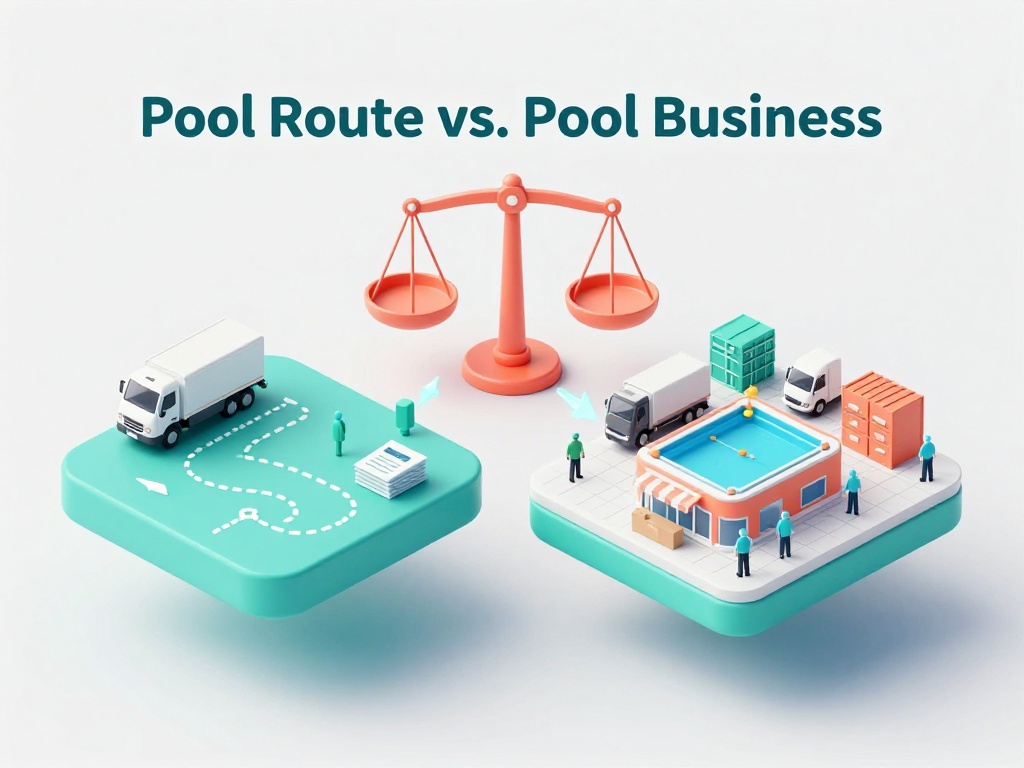
Think of it this way: a construction company has to win the bid, order materials, manage labor scheduling, and hope the weather holds. A pool route for sale has already done the hard part. It has converted neighborhood homeowners into monthly subscribers who expect a clean pool and a backwash every week. When you buy a pool route for sale, you are buying that subscription list, not a bid list. That is why the best pool route for sale opportunities are priced on a Seller’s Discretionary Earnings (SDE) multiple rather than on gross construction revenue.
Hidden Risks in a Mixed Pool Business
Mixed models carry three hidden risks that a focused route avoids. First, construction work requires licensed contractors, insurance riders, and bonding that a service-only operator may not carry. Second, project revenue swings with the economy and interest rates, so a company that leans on renovations will see wild monthly variance that a pure pool route for sale rarely shows. Third, the skill set is different: construction managers think in weeks and change orders, while route operators think in routes and retention. When you separate the books, you can value the service component independently.

How to Value a Pool Route for Sale
Valuing a pool route for sale correctly starts with one metric and one metric only: Seller’s Discretionary Earnings, or SDE. SDE strips out the owner salary, owner benefits, and non-recurring expenses to show what the business truly generates for a working owner-operator. Once you have clean SDE, you apply an industry multiple that reflects customer count, churn rate, and geographic density. A healthy listing usually trades in the 1.8x to 2.8x SDE range, with premium routes commanding closer to 3.0x when churn is low and the territory is well mapped.
Valuing a pool route for sale well means rebuilding the seller’s numbers yourself. Start with the profit-and-loss statement, then rebuild SDE line by line. Add back any salary or draw the owner took, add back personal vehicle expenses if the owner used a personal truck, add back life insurance or health benefits run through the business, and subtract any discretionary spending you will not continue. Be aggressive here: a sloppy listing often hides owner perks that inflate expenses and deflate the real earnings you would inherit.
Pulling SDE From a Route Listing
Once you own a clean SDE number, sanity-check it against the customer count. Divide annual SDE by the number of active customers, then multiply that per-customer profit by 12 to confirm the monthly economics make sense. If a listing claims 80 customers but only generates $1,000 of monthly profit, the math probably relies on owner overtime that will not scale under new ownership. That warning sign appeared in the pest control and auto-repair spaces, where recurring service routes outvalued project-heavy twins.
Choosing the Right SDE Multiple
The SDE multiple is where most buyers of a pool route for sale either make their margin or lose it. A pure service route with low churn, dense geography, and simple chemistry-based billing usually commands the top of the range, because scalability is high and training new technicians is straightforward. A listing that relies on heavy equipment repair, specialty chemicals, or a scattered geography trades lower, because churn risk and labor complexity rise. Run the numbers conservatively: assume a 15 to 20 percent drop in customers in year one, and confirm the price still works.
Geography is the second lever that moves the multiple on any deal. Routes that fit within a 20-minute drive radius benefit from low fuel costs, predictable scheduling, and a real moat against competitors who cannot efficiently serve the same neighborhoods. A scattered listing, by contrast, bleeds profitability through drive time and makes it harder to retain technicians. Before you decide how to acquire a route in a new market, map the customer pins and measure the radius. If the pins fan out beyond a reasonable circuit, negotiate a discount or walk away; only a geographically tight listing is worth a premium.
Finally, compare the asking price to broader market data before you commit. The same principles that govern how to value a small business apply here: look at comparable service businesses, review recent M&A transactions in the pool industry, and benchmark churn and ticket growth against regional averages. Publicly available industry reports from groups like the Pool & Hot Tub Alliance (https://www.phta.org/) track average revenue per customer and retention rates by region, giving you an external benchmark for the opportunity you are analyzing.
Key Due Diligence Checklist When Buying a Pool Route for Sale
Due diligence on a pool route for sale is where most buyers earn or lose money, because the financials are only half the story. You also need to validate that the customers are real, that the churn rate is sustainable, and that the service agreements actually protect recurring revenue. The best way to learn how to buy a pool route for sale without regret is to work through a written checklist before you sign a letter of intent, not after.
1. Verify Customer Contracts and Pricing Files. Request the full customer list with start dates, current pricing, payment history, and signed service agreements. A clean listing will show customers on automatic payment with 10 to 24-month average tenure; a distressed listing will show frequent start-stop patterns and cash-on-delivery payments. Confirm that each file includes the property access instructions, special chemical notes, and contact method the technician uses on every visit.
2. Validate Revenue at the Source. Call a random sample of customers yourself and ask about their recent service, their satisfaction level, and whether they received a price-change notice. If customers answer quickly and positively, you have validation. If they hesitate, mention a price increase they never saw, or seem unsure about the service agreement, you have uncovered churn risk that no spreadsheet will warn you about clearly enough.
3. Review Equipment, Vehicles, and Supply Agreements. Walk the storage area for the listing and photograph every piece of equipment, from the service pole to the chemical test kit to the vacuum hose. Cross-reference serial numbers against the asset schedule, and check that supply contracts for chlorine and acid are transferable or that you can negotiate new terms. The equipment itself is usually worth far less than the customer list, but a poorly maintained fleet is a red flag for technician safety and service quality. Learning how to acquire a listing means learning which assets depreciate fast and which assets retain value, and chlorine tabs are decidedly in the first camp.
4. Audit Insurance, Licenses, and Legal Exposure. Most jurisdictions license pool-service operators and require commercial auto insurance on any truck used for regular service. Request proof that the seller of the listing carries current commercial liability, workers compensation, and vehicle coverage, and that no claims are pending. A missing license or an uninsured claim can crater the value of a deal overnight, because buyers will inherit the regulatory and reputation risk along with the customer list. If the seller cannot produce clean documentation, treat the price as inflated until you can obtain quotes to remedy the gaps.
5. Stress-Test the Financials With Three Scenarios. Model the business under a best-case, base-case, and worst-case churn assumption, holding the per-customer price and frequency flat. A resilient listing should still cover fixed costs and pay a reasonable owner draw in the worst case, because real-world routes lose customers during moves, divorces, and pool replastering projects. If the worst-case scenario shows negative cash flow, you either need a much lower entry price or you need to pass and preserve capital for a better opportunity. That triage is the single most important filter in knowing how to evaluate a deal objectively.
What to Look for in Equipment, Trucks, and Customer Contracts

The operational side of a pool route for sale lives in three places: the service vehicle, the chemical storage system, and the digital customer file. Each of these elements scales differently under new ownership, and a sharp buyer evaluates them independently before deciding which opportunity fits their capacity. Getting this right prevents the classic mistake of falling in love with a listing whose numbers look great on paper but whose operations collapse under real-world execution.
Vehicle and Fuel Economics. The service vehicle on a listing is usually a pickup or cargo van plumbed for chemical storage, and its age directly affects fixed costs. A newer vehicle lowers immediate capital needs but may have been customized to the seller’s routing preferences. When evaluating an opportunity, budget for a full vehicle inspection, a chemical-spill kit upgrade, and updated routing software so the next owner can maintain efficiency without re-learning the territory. A well-maintained truck can justify a slight premium; a rust-bucket is a negotiation lever, not a selling point.
Chemical Inventory and Supply Agreements. Chemistry is the backbone of the operation, and the relationship with the local distributor determines both product cost and service reliability. A strong listing will show a preferred-supplier agreement, a chemical storage log, and evidence of consistent product quality. A weak listing will show frequent supplier switches, customer complaints about staining, or inventory purchased opportunistically at retail markup. Because chlorine and acid represent a large share of variable cost, locking in favorable terms is often what separates a profitable route from an unprofitable one.
Customer File Quality and Retention. The final piece of the business is its customer database, and the best listings store files digitally with service notes, chemical readings, and payment history. When you inspect an opportunity, flag any accounts with more than two service interruptions in a year, because interruptions usually precede churn. Also check whether the listing uses automatic payment processing or collects cash on delivery; automatic payment is worth a measurable premium because it removes collection risk and smooths cash flow for the buyer.
Financing a Route Purchase and Seller-Financing Options
Most buyers of a pool route for sale do not have enough cash on hand to pay the full asking price outright, and that is where creative financing becomes a strategic tool. Conventional bank loans can cover 60 to 70 percent of the valuation, but lenders will want to see at least two years of clean financials and will scrutinize churn. Seller financing is the bridge most sellers accept gladly, because an earn-out structure aligns incentives and preserves cash flow during the transition.
When negotiating how to buy this business, propose a structure that protects both parties. Ask the seller to finance 15 to 30 percent of the purchase price with a 3- to 6-month interest-only period followed by a 36- to 48-month amortization. That seller note reduces lender risk on the loan, often unlocks a better interest rate, and gives the seller a continuing upside if the transition succeeds. A well-structured deal includes an earn-out tied to customer retention, so the seller has direct motivation to stay involved long enough to introduce the new owner to the most finicky accounts.
The transition period is where most buyers of a pool route for sale make or break their investment. Plan for a 60- to 90-day shadow period in which the seller works alongside you, handles the toughest customer calls, and gradually steps back as retention data stabilizes. A listing that transitions cleanly usually retains 90 to 95 percent of customers in the first 90 days, which justifies the premium pricing models we discussed. A deal that loses 10 percent or more in the same window may still be a good deal, but only if the price accounts for the customer-replacement cost you will incur as the new owner.
One of the most common mistakes when buying a pool route for sale is over-borrowing relative to the first 12 months of cash flow. Even a clean listing can see seasonal dips in December and May, when customers delay service for holidays or weather. Build a 12-month cash-flow model before you commit to any loan, and keep a reserve equal to two months of operating expenses plus the seller-financing note. That buffer is what lets you focus on improving retention and growing ticket size after you own the business, rather than scrambling for working capital when the first repair bill arrives.
The Bottom Line on a Pool Route for Sale. A pool route for sale rewards buyers who treat it as a customer-retention business rather than an equipment purchase. The recurring revenue, low inventory risk, and scalable service model make this opportunity one of the few small-business investments that can pay for itself within the first year while also supporting part-time or full-time ownership. If you have followed the due-diligence checklist, validated SDE with a clean multiple, and structured financing that preserves liquidity, you are positioned to close with confidence and grow the business profitably.
When weighing a pool route for sale against a construction-heavy company, the key decision is cash-flow predictability. A pure listing thrives on recurring service calls, whereas a renovation-heavy company depends on permitting cycles and project timing.
To learn how to buy a business with confidence, start by reading the complete guide on how to buy a business, then build your own due diligence checklist for buying a business before you bid. The same principles that govern how to value a small business apply here: focus on SDE, verify churn, and structure financing that preserves liquidity. With that framework, the right opportunity can become a low-maintenance, high-retention asset that pays for itself within the first year of ownership. For a deeper walk-through of the math, review our separate guide on how to value a small business for sale.
Frequently Asked Questions
🏊 Pool Route For Sale FAQ
How much is a typical pool route for sale worth?
A pool route for sale is typically valued at 1.8x to 2.8x Seller’s Discretionary Earnings, with premium routes in dense markets commanding up to 3.0x. Use clean SDE and customer churn as your primary filters.
Is a pool route for sale better than a pool construction business?
Yes, for most buyers. A pool route for sale provides recurring monthly revenue with low inventory risk, while a construction-heavy company adds lumpy project revenue, permitting risk, and higher labor complexity.
What churn rate should I expect on a pool route for sale?
A healthy pool route for sale retains 85 to 95 percent of customers annually. Routes with churn above 15 percent usually indicate service-quality problems and should be discounted or avoided.
How much should I put down when buying a pool route for sale?
Plan for 30-40 percent down on a pool route for sale, with the balance split between an SBA loan and seller financing. Keep two months of operating reserves to cover seasonal cash-flow dips.
@type: FAQPage ·
4 questions
📋 JSON‑LD embedded in original block
Here are the answers to the most common questions about buying and valuing a pool route for sale.
Final Thoughts on a Pool Route for Sale
A pool route for sale is one of the most accessible ways to own a recurring-revenue asset, and the decision between a listing and a construction-heavy company comes down to cash-flow predictability. A purely recurring listing thrives on service calls, whereas a renovation-heavy company depends on permitting cycles and project timing.
To learn how to buy a business with confidence, review the complete guide on how to buy a business and keep a due diligence checklist for buying a business handy as you evaluate opportunities. The same principles that govern how to value a small business apply here: focus on SDE, verify churn, and structure financing that preserves liquidity. With that framework, the right listing can become a low-maintenance, high-retention asset that pays for itself within the first year of ownership.