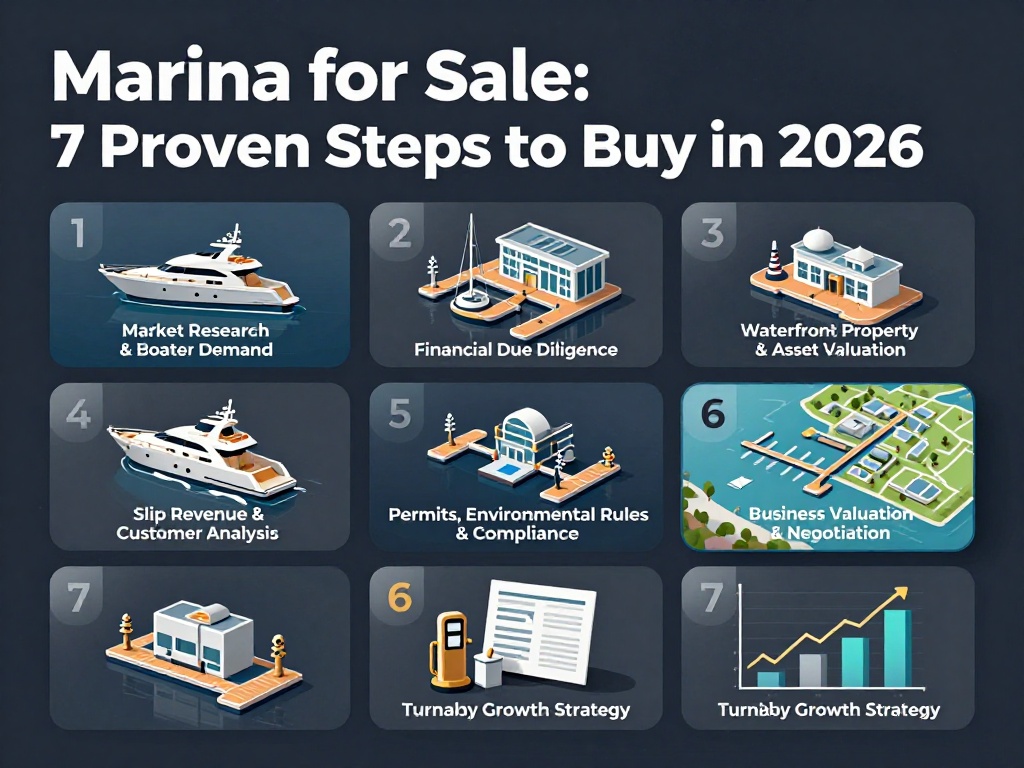
Marina for Sale: 7 Proven Steps to Buy in 2026
marina for sale offers waterfront scarcity that rarely trades in 2026 as owners age and coastal development tightens. This guide shows how to evaluate a marina for sale without overpaying for view alone, focusing on slip occupancy, service revenue, and environmental permits. You will learn the checks that separate a cash-flowing harbor from a money pit needing dredge and seawall work.
Why a Marina For Sale Is Attractive in 2026
Many buyers chase slip count for any marina for sale, but utilization and rate power determine value. A well-run harbor has waiting lists, documented slip turnover, fuel sales with stable margin, and service bays that bill labor hours. Filtering early protects capital, and our boat dealership for sale valuation primer shows how waterfront businesses are priced on SDE plus waterfront scarcity premium.
Demand for boating persists where access is limited. A marina for sale with diversified income across wet slips, dry storage, fuel, service, and winterization survives losing any single season better than one depending on summer dockage alone. Study where slip holders live and whether marketing targets similar ownership demographics effectively.
Margins improve with service labor and storage fees. The best operators of a marina for sale earn strong margin on repair labor and winter storage while keeping dockhand labor under 35 percent of revenue. Review fuel gallon trends, service work orders per month, and whether storage is pre-booked before season starts.
How the Business Makes Money
Scalability for a marina for sale comes from systems, not just water. A dockmaster can run multiple basins when reservations, billing, and maintenance live in written routines. This leverage supports adding drystack or brokerage when the core marina runs without the owner. Verify routines exist and staff follow them daily.
Check riparian rights, permits, and insurance first for any “M F S”. Verify the entity holds submerged land lease, Army Corps and state environmental permits, and liability coverage for fueling and haul-out. A clean compliance file reassures lenders and prevents surprise enforcement that halts operations after closing.
Audit occupancy and rate history next. Healthy marinas carry 88 to 98 percent occupied slips with annual escalators and waitlists equal to 15 percent of capacity. For a marina for sale, review slip registry, rental agreements, and arrears for 24 months. Confirm seasonal transient nights and that rate increases stuck without material churn.
Valuation and Pricing
Staff depth matters on the waterfront. Durable harbors have a dockmaster and service manager who can each launch boats, assign slips, and close the fuel dock. Interview them separately. For a marina for sale, confirm whether mechanics are certified, subcontractors insured, and whether the owner is the only person trusted to quote yard work.
Underwrite on trailing twelve months and normalize owner benefits and one-time dredge or storm costs. Concentration risk appears when one yacht club or fishing charter controls 15 percent of slip revenue. Ask the seller of a “M F S” to facilitate introductions to those tenants and secure estoppel certificates confirming lease terms.
Working capital is seasonal for a marina for sale. Storage and service deposits arrive in fall while payroll peaks in spring commissioning. The SBA 7(a) loans resource explains how SBA treats seasonal working capital when you buy an existing business, including appropriate cash cushions for the first off-season.
Due Diligence Checklist for a Marina For Sale
Small marinas trade around three to four times SDE, larger institutional harbors at five to seven times EBITDA depending on waterfront ownership. Earnings of 500,000 in SDE for a “M F S” might list near 1.5 to 2.0 million, with owned upland and fee-simple submerged land commanding premiums over leased bottom.
Map competing harbors within 30 miles, check fuel prices, and verify pump certifications. A strong marina for sale holds waiting lists, clean fuel compliance, and no single fuel supplier demanding exclusivity that caps margin. Search for new drystack approvals that could add supply and pressure occupancy.
Confirm yard capabilities, travel lift ratings, and environmental controls. Observe haul-out, blocking, and bottom-paint processes for containment and safety. A marina for sale with certified lift operators, documented haul logs, and proper waste handling retains insurance and avoids fines that destroy margin.
Seasonality is managed with annual contracts and winter services. A “M F S” entering fall with pre-sold winter storage, shrink-wrap, and engine service smooths cash flow. Review 24 months of monthly revenue to separate true seasonality from rate discounts given to fill empty slips.
Watch for unrecorded cash, barter slips, and personal boats buried in costs. Transient cash, broker commissions, and owner family slips sometimes bypass the marina management system. For a marina for sale, reconcile the dock system, fuel POS, and bank deposits line by line, and question gaps over two percent.

Financial Verification
Owner dependency derails waterfront transitions. Structure ninety-day handovers with introductions to yacht clubs, fishing captains, and service customers. A marina for sale that depends on the owner knowing every slip holder by name needs a dockmaster who can assume those relationships with written handover notes.
SBA programs allow ten to twenty percent down under five million when the marina for sale shows stable occupancy and environmental compliance. On day one confirm fuel supplier credit, slip billing under your tax ID, and meet every tenant. Our campground for sale financing note shows how lenders treat seasonal hospitality collateral similarly.
Technology and marketing diversity support value for a marina for sale. Dock management software, online reservations, and referral from brokers should run without owner input. Evaluate lead sources for the last year and confirm no single brokerage drives over 50 percent of new slip holders, which creates concentration risk.
Operations, Staffing, and Systems
Evaluating a marina for sale starts with waterfront due diligence. Walk every dock, probe pilings, inspect bulkheads and seawalls for cracks, and review the last dredge survey. Check depth at mean low water against the fleet you serve; shoaling that limits draft to five feet excludes larger boats and cuts addressable demand.
Staffing costs and service mix define margin for any “M F S”. Verify mechanic payroll, dockhand hours, and workers compensation against work orders. Check whether family members draw salaries without yard duties, since those add-backs adjust SDE legitimately but must be documented and sustainable after close.
Customer concentration analysis matters for a marina for sale. Pull revenue by slip holder and service customer for 24 months and flag anyone exceeding ten percent of total sales. Written commitments from key tenants, along with assigned slip agreements, reduce perceived risk and support stronger valuations.
Market, Location, and Competition
Upland ownership and lease terms drive long-term security for a marina for sale. Confirm whether upland is owned fee-simple or leased, remaining term, renewal options, and assignment clauses. Calculate rent as percent of revenue and confirm dredge spoil disposal rights, since losing spoil rights can makes future dredging impossible.
Environmental and fuel system condition sets capex. Inventory tanks, lines, and containment with age, tests, and insurance. A “M F S”with single-wall tanks near end of life may need six-figure replacement within two years. Negotiate credits or escrow to cover fuel system upgrades and avoid post-close cash shock.
Service and storage analytics reveal margin quality for a marina for sale. Track work orders per mechanic, average ticket, and storage pre-book rates. Bays billing 75 percent of available hours and storage 90 percent pre-sold indicate strong utilization. Low billable hours signal pricing or staffing mismatches worth fixing.

Financing Your Purchase
Marketing audit should verify transient marketing and slip waitlist health. For a marina for sale, request occupancy, transient nights, and source of new customers for 12 months. A healthy transient ADR and repeat seasonal guests show destination strength. Confirm whether marketing depends on the owner personally calling brokers.
Legal review for a marina for sale must include slip agreements, fuel contracts, and storm plans. Verify agreements allow rate increases, assignment on sale, and late-fee enforcement. Unrecorded oral promises of lifetime slip rates destroy value if not reset before transfer and can trigger litigation after closing.
Growth levers for a marina for sale include adding drystack racks, brokerage, ship store expansion, and winter service bundles. Underwrite each lever with permit feasibility, not optimism. A drystack expansion, for example, needs Army Corps approval and upland space already entitled, plus a service team capable of handling the extra winterization volume.
Transition and Growth Plan
Final diligence for a marina for sale should include sea-trial slips, fuel flow tests, and interviews with long-term slip holders. Verify service mix, fuel margin, and supplier terms against local harbor data. A harbor with documented repeat tenants and clean environmental reports commands higher retention after the sale.
Negotiate price on verified SDE and waterfront risk. For a “M F S”, require a Phase I environmental, seawall inspection, and hydrographic survey for deals touching waterfront, and secure working capital peg tied to deferred storage revenue. Push for seller note of 10 to 15 percent to align incentives through hurricane season and dredge review.
Transition plan should lock in the dockmaster and service manager with retention bonuses, keep slip assignments stable for one season, and communicate billing continuity clearly. A marina for sale that retains its tenants through a well-managed handover keeps occupancy flat while you learn harbor operations, then grows through brokerage and service upsell.
Buying well means prioritizing occupancy depth, waterfront permits, and yard fundamentals. Start diligence early, use the checklist links above, and walk away if seawall, dredge, or occupancy fails your thresholds. A disciplined process helps you close a marina for sale that thrives under your stewardship and compounds with scarcity.
Insurance and storm preparedness for a marina for sale require detailed review of wind and flood coverage, dock replacement values, and business interruption. Confirm named-storm deductibles and whether floating docks are insured to full cost. A marina for sale with gaps in storm coverage can face six-figure uninsured losses.
Ancillary revenue streams for a marina for sale include ship store, brokerage, and winter service bundles. Evaluate each line for margin and seasonality. A marina for sale that monetizes storage, service, and fuel spreads risk across seasons and supports year-round staffing.
Customer demographics for a marina for sale shape slip pricing. Analyze boat length, ownership type, and home zip codes. A marina for sale serving local day boaters versus transient cruisers prices and markets differently and holds distinct waitlist dynamics.
Technology for a marina for sale spans reservation and fuel management. Evaluate whether slip billing, transient reservations, and fuel logs integrate. A unified marina management system that automates late fees and tracks electricity reduces dockmaster workload and leakage.
Sales and leasing process for a marina for sale should be documented from inquiry to signed slip agreement. Mystery shop inquiries, track response time, and review deposit capture. A marina for sale that closes 50 percent of qualified inquiries indicates strong dock presence and clear pricing.
Pricing strategy for a marina for sale balances occupancy and yield. Compare linear foot rates, amenity fees, and fuel margins to neighboring harbors. A marina for sale under market with waitlists can lift rates annually, while an overpriced harbor needs improved service or dredge depth to justify premiums.
Community and events for a marina for sale drive retention. Look for fishing tournaments, rendezvous weekends, and dock parties that build tenant community. A harbor where slip holders know neighbors renews at higher rates than one offering only a place to tie up.
Competitor deep dive for a marina for sale should include dock walks and fuel price audits at three nearby harbors. Identify what tenants praise—clean heads, helpful dockhands, or secure storage—and replicate strengths. A marina for sale that fixes a competitor complaint about shallow depth wins larger boats.
Financial ratios for a marina for sale include revenue per slip, labor per occupied slip, and fuel margin per gallon. Benchmark each against peers. A marina for sale with rising revenue per slip shows pricing power after amenity upgrades, while flat revenue signals discounting to fill.
Tax and deal structure for a marina for sale hinge on waterfront ownership and asset versus stock. Clarify whether submerged land lease transfers, who owns dredge permits, and how slips are deeded. An asset purchase may let you step up dock basis for depreciation.
Lease and submerged land terms for a marina for sale need close attention. Push for 20-year submerged land lease with renewal, caps on lease fees, and clear assignment on sale. A marina for sale with state or federal lease uncertainty faces re-bid risk that lenders dislike.
Fuel system financing for a marina for sale should be mapped. Separate owned versus consigned fuel, tank ownership, and environmental indemnity. A the business where tanks are consigned by the fuel supplier reduces capital but may cap margin and limit brand choice.
Marketing for a the business should be diversified beyond broker referrals. Evaluate broker, repeat tenants, transient platforms, and yacht club partnerships. A the business with 40 percent of new tenants from repeat and referral indicates strong experience that brokers amplify.
Frequently Asked Questions
Common questions from buyers evaluating a the business are answered below. Use these to focus diligence and financing conversations for a the business before you sign a letter of intent.
Operational checklists keep daily execution consistent without owner oversight. Review opening, midday, and closing routines for completeness and sign-off discipline. A business where checklists are signed and audited weekly shows staff accountability that buyers value.
Supplier relationships affect margin and continuity. Confirm primary and backup suppliers, payment terms, and whether pricing is contracted. A business that can switch suppliers without service interruption demonstrates resilience buyers pay for.
Financial controls such as daily cash reconciliation and weekly inventory counts prevent leakage. Inspect whether the point-of-sale ties to deposits and whether variances trigger investigation. Strong controls for this type of operation reassure lenders and justify multiples.
⚓ Marina For Sale FAQ
What makes a marina for sale a good investment?
Scarce waterfront, high occupancy, and service revenue make a marina for sale valuable. Owned upland and permitted slips support premium multiples.
How do I evaluate a marina for sale?
Walk docks, inspect seawalls, review slip registry, fuel compliance, and environmental permits. Confirm the dockmaster can operate the marina for sale without the owner.
How much does a marina for sale cost?
Marinas list at 3 to 4 times SDE small, 5 to 7 times EBITDA large. A marina for sale at 500,000 SDE may list 1.5 to 2.0 million based on waterfront ownership.
What financing fits a marina for sale?
SBA 7(a) with strong occupancy and environmental reports, plus conventional waterfront lenders. Fuel system and dredge condition affect collateral for a marina for sale.
@type: FAQPage ·
4 questions
📋 JSON‑LD embedded in original block
Final Thoughts
Retention for a the business relies on service and community. Look for preventive maintenance reminders, winterization clinics, and dockhand responsiveness metrics. A systematic service follow-up for a the business preserves occupancy while you learn harbor operations.